State Determines Everything
Why you don’t rise to your intentions… you fall to your state

The version of you that exists during a calm morning coffee doesn’t exist during a fight with your partner.
This is the version of you that knows exactly how you want to show up:
Patient.
Connected.
Clear.
Grounded.
Loving.
The one who has thought it through.
Reflected.
Had the conversations in your head.
The you who knows what you would say.
How you would respond.
Who you want to be.
That person vanishes when the moment comes. And no amount of good intentions brings them back:
Pressure rises.
Emotion enters.
Something doesn’t go the way you expected.
And suddenly…
You hardly recognize yourself.
I call this State Collapse:
the moment your regulated self goes offline and a narrower version takes over.
Your tone changes.
Your body tightens.
Your reactions get faster.
You interrupt instead of listening.
Defend instead of staying open.
Withdraw instead of connecting.
And afterward, there’s that familiar question:
Why did I do that?
But the better question is this:
Why does the access to the version of ourselves we trust the most… disappear the moment we need it most?
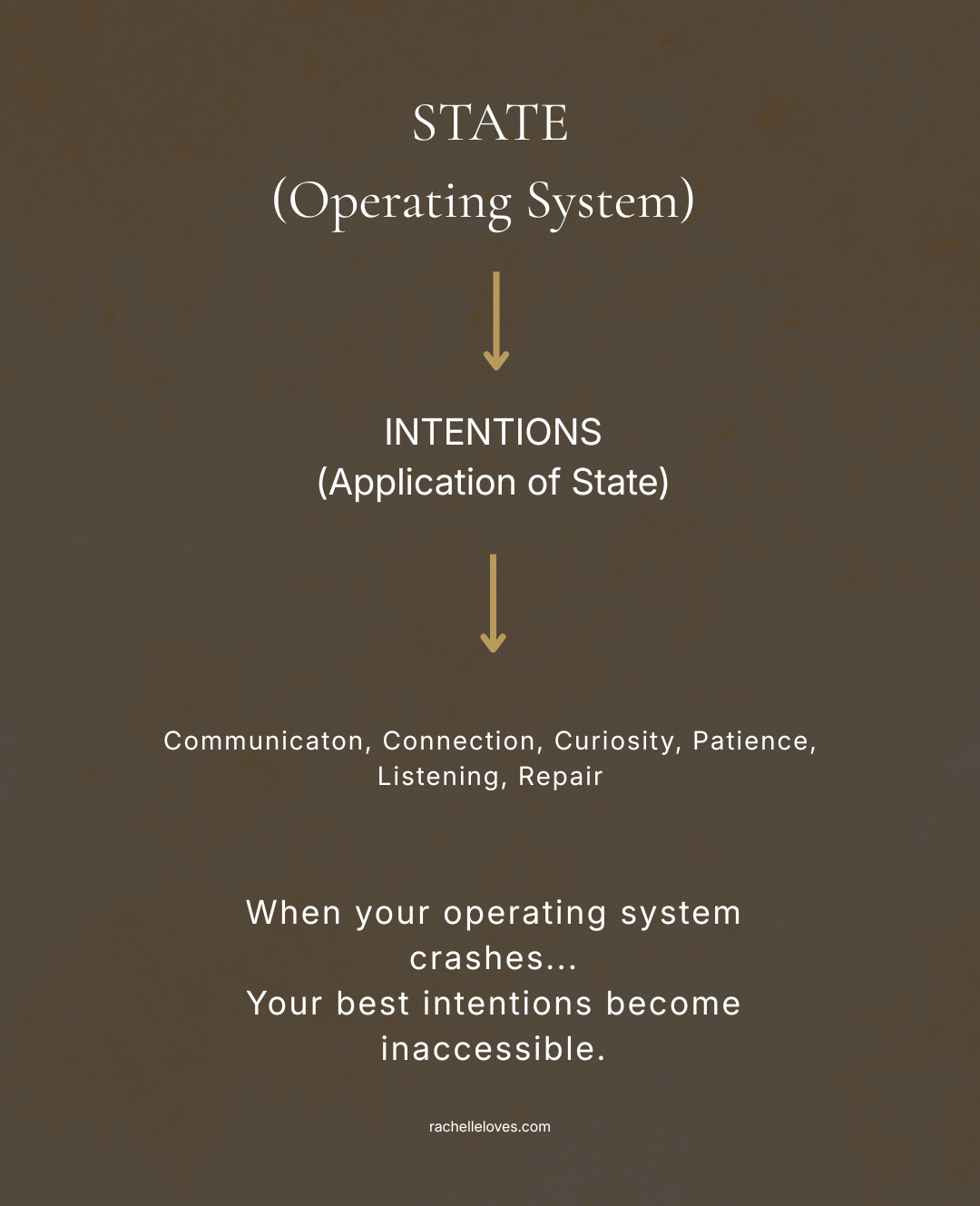
Think of it like this: State is the operating system. Intentions are the apps. You can download all the apps you want. But if the OS is crashing, none of them will open. Nothing will be accessible for use.
For a long time, I thought this was a communication problem.
If we just had better tools…
better language…
better strategies…
we would be able to stay connected.
But that didn’t explain what I was actually experiencing.
Because I didn’t lack awareness.
I lacked access.
Access to the version of me that knew how to stay.
And that’s when something began to shift.
Maybe this isn’t about knowing what to do.
Maybe this is about the state I’m in when it matters.
Here’s what I’ve come to understand:
You don’t rise to your intentions.
You fall to your state.
This is not a metaphor or a mindset or one of those things you underline in a book and forget by Thursday-It’s the single most reliable predictor of whether you’ll become the person you intended to be...
or the person your nervous system decided you’d become.
Your state determines what you see.
It determines what you feel.
It determines what you’re even capable of in the moment.
When your nervous system is regulated, the world feels different.
There’s space.
Curiosity.
Choice.
You can listen.
You can feel.
You can stay.
But when your system is activated…
Everything narrows.
Neutral becomes threatening.
Feedback feels like criticism.
Disconnection feels like danger.
And suddenly, the very things you value most…
become inaccessible.
Not because they’re gone.
But because your state changed your reality.
You can see this most clearly in relationships.
You intend to listen… but you interrupt.
You intend to connect… but you defend.
You intend to soften… but you close.
Same person.
Different state.
You can see it in sport too.
You’ve practiced.
You’re standing on the baseline.
You’ve hit this serve a thousand times.
Your partner looks at you.
You know exactly what to do.
Then the score becomes 10-10.
Suddenly...
Everything changes.
Nothing about your skill disappeared.
But your state changed your performance.
If you’ve ever been told you’re too much-too emotional, too reactive, too intense-this hits even deeper.
You’ve probably spent years trying to dial yourself down. But the issue was never your intensity. It was that nobody taught you how to hold it. You don’t need to become smaller or less intense. You need to become more capacious.
You feel everything more.
You care deeply.
You want connection, truth, aliveness.
But when that intensity rises in the body…
Without capacity to hold it, it turns into:
Reactivity.
Overwhelm.
Disconnection.
Not because you’re too much.
Because you were never taught how to stay with that much energy in your system.
So most people try to solve this at the level of behavior.
They try to say the right thing.
Do the right thing.
Control the moment.
But behavior is downstream.
If your state is unstable…
your behavior will follow.
Which means the real work is not:
“How do I communicate better?”
It’s:
“Can I stay in a state that allows connection… when pressure rises?”
And that changes everything.
Because now the moment you feel the shift…
That’s the work.
The tightening in your chest.
The urge to defend.
The impulse to withdraw.
Instead of fixing it immediately…
You learn to notice it.
To stay with it.
Even for one breath longer than you normally would.
Not perfectly.
Not all at once.
But enough to begin training something new.
Because this is the part no one teaches.
You don’t train this in calm conversations.
We like to imagine we’ll become more patient in peaceful moments.
But patience isn’t built there.
Capacity isn’t built there.
Presence isn’t built there.
It’s built exactly where you’d rather leave.
In pressure.
In activation.
In real-time experience.
The Pause That Trains
This is the practice: when you feel the shift, stay for one breath longer.
That’s it. That’s the whole thing. Everything I teach is an elaboration of that one breath.
Most people will read this and move on. One breath? That can’t be enough. The mind wants something more complicated-a framework, a protocol, a 12-week system. But the mind isn’t what needs training here. The nervous system is. and the nervous system doesn’t learn through complexity. It learns through repetition of something simple in the moments that count.
This is where everything starts to change.
Not because you became a different person…
But because you became someone who could hold yourself in the moment you used to lose yourself.
State is not just something to manage.
It’s something to be devoted to.
Because what you are in your state…
is what you bring into your relationship, your work, and your life.
Not your intentions.
Not your ideas.
Your state.
So the next time you don’t show up the way you wanted to…
Don’t ask:
“Why did I do that?”
Ask:
“What state was I in…
and have I ever trained myself to stay there under pressure?”
Because your life is not shaped by what you intend.
It’s shaped by what you can hold.
So the real question isn’t whether you have good intentions. It’s whether you’ve ever actually trained the one thing that determines whether those intentions survive contact with reality.
Have you?
____________________________________________________________________________
If Essay #1 asked, “What is the problem?”
The answer was:
Intensity isn’t the problem. Capacity is.
This essay asks a different question:
What determines our capacity?
Our state.
If you haven’t read the first essay yet, I’d recommend starting there:
→ The Problem Isn’t Intensity
Continue the Conversation
Previous Essay
← The Problem Isn’t Intensity
Next Essay (”Coming Next”)
→ Activation vs. Aliveness